Best Elevator Products
"Modern Home Elevators in Hyderabad—Redefining Comfort and Convenience."
Elevator Performance
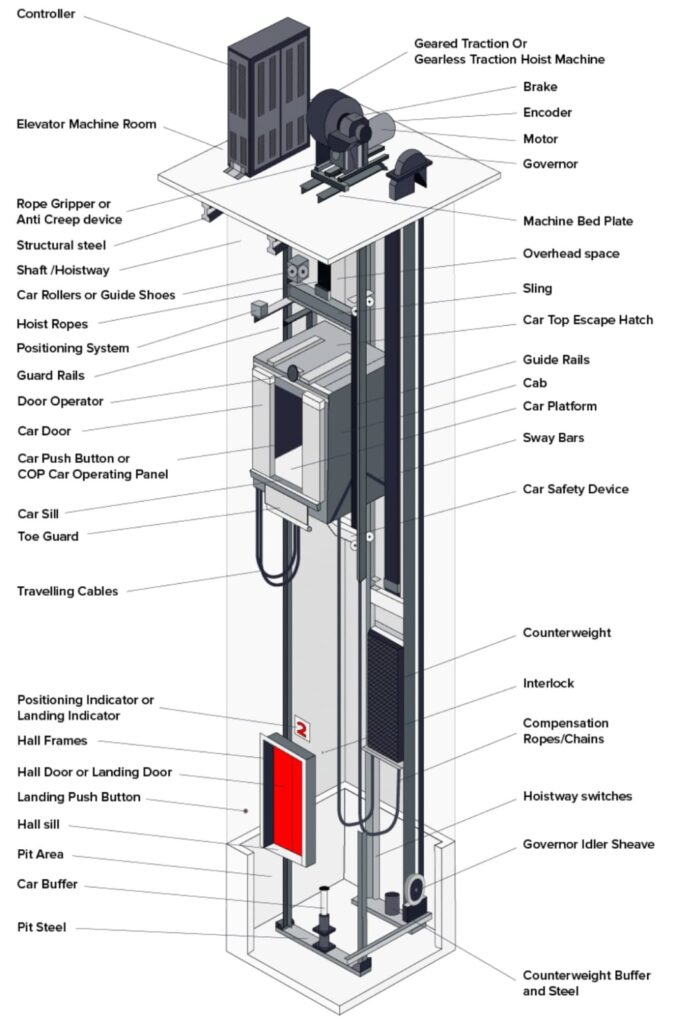
Elevator Parts Technical Overview
This diagram illustrates the complete architecture of a traction-type elevator system, designed with advanced engineering principles to ensure optimal performance, safety, and reliability. At the top of the hoistway, the traction machine provides motive power to the elevator, utilizing a high-efficiency motor and traction sheave that move the hoist ropes connected to the car and counterweight. The overspeed governor continuously monitors the elevator’s speed, automatically engaging the safety gear to stop the car securely in case of abnormal motion. The elevator car, built with precision-balanced framing and vibration-resistant suspension, travels vertically within the shaft along hardened steel guide rails that guarantee stable, noise-free movement. A counterweight assembly operates simultaneously to balance the load, reduce motor effort, and enhance energy efficiency.
The control cabinet, equipped with intelligent microprocessor-based systems, coordinates all operational functions—speed regulation, acceleration, deceleration, door operation, and leveling accuracy. Landing doors at each floor are interlocked with the car doors to prevent access during movement, ensuring full passenger safety. At the shaft base, car buffers and counterweight buffers made of high-grade oil or spring materials absorb impact forces, providing an additional safety layer in case of emergency descent. Supporting elements such as tension pulleys, traveling cables, and guide rail brackets maintain system alignment, smooth motion, and reliable electrical connectivity throughout operation.
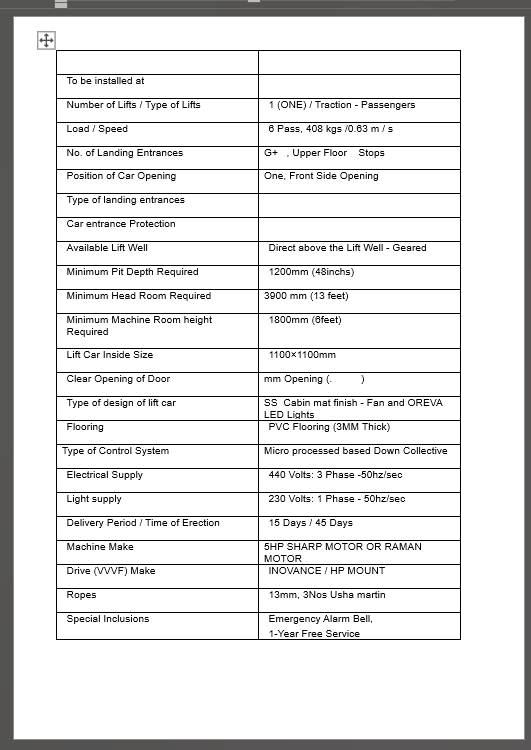
Elevator List of Specifications